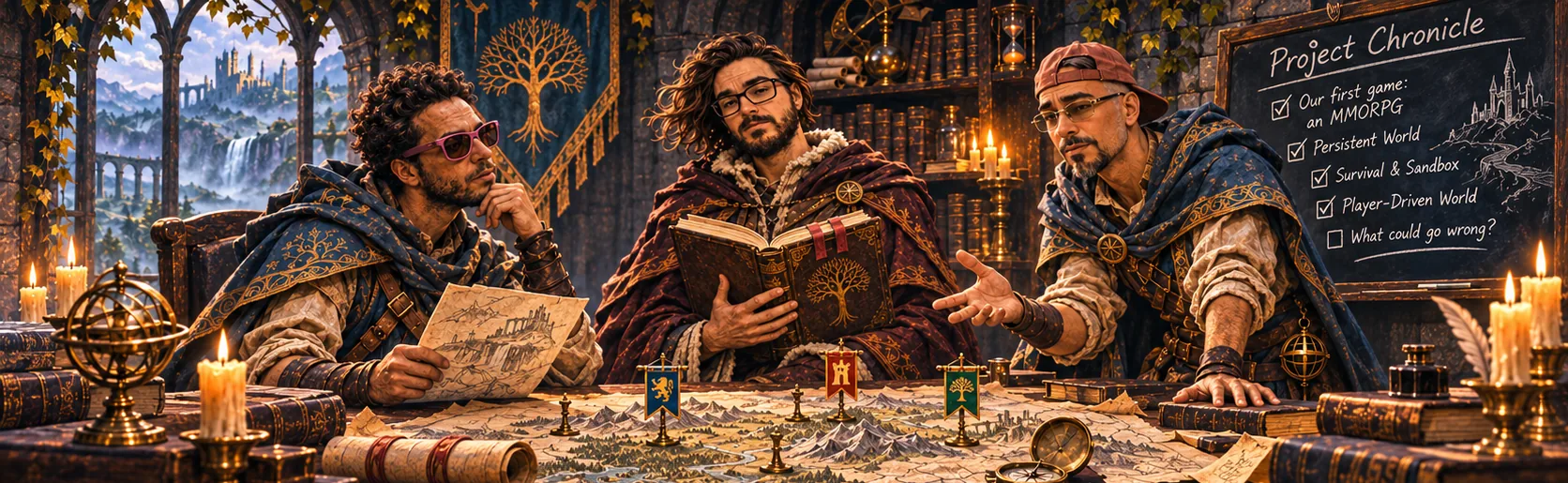
There's a pretty well-known rule in game development:
"If you're making your first game, don't start with an MMORPG."
It's excellent advice.
Reasonable, sensible, and backed by countless stories of projects that never saw the light of day.
Naturally, we decided to ignore it.
In fact, we thought we'd throw in a persistent world, survival mechanics, regional economies, player-built settlements, politics, wars, and a fantasy universe that evolves over time.
After all, what could possibly go wrong?
Welcome to Project Chronicle.
Project Chronicle is our attempt to build a fantasy survival sandbox MMORPG set in a persistent, player-driven world.
We're two software developers from the fintech world, tackling our first game with equal parts engineering experience, enthusiasm, and questionable judgment.
So, Who Are We, Exactly?
We're Erwin and Federico, the two founders of Aternum Software, a small Italian software development company.
We've been working in software development for around fifteen years, and for the past three, we've been building Aternum Software, focusing primarily on business solutions, management applications, and projects in the business and fintech sectors.
Basically, we've spent a good portion of our professional lives dealing with code, databases, software architecture, business processes, and problems that, for some mysterious reason, always seem to appear on Friday afternoons.
It's an interesting world. Complex. Challenging.
But at some point, we asked ourselves a question:
What if we took everything we've learned and used it to build something we've always wanted to experience as players?
A seemingly innocent question.
The kind that, in the worst-case scenario, leads to a small side project you work on in your spare time.
Well, apparently we misunderstood the small part.
Luckily, we're not doing this alone. Nicholas has been part of Chronicle since its earliest ideas and continues to share the journey with us. The three of us are the team behind Project Chronicle.
From Fintech to Fantasy
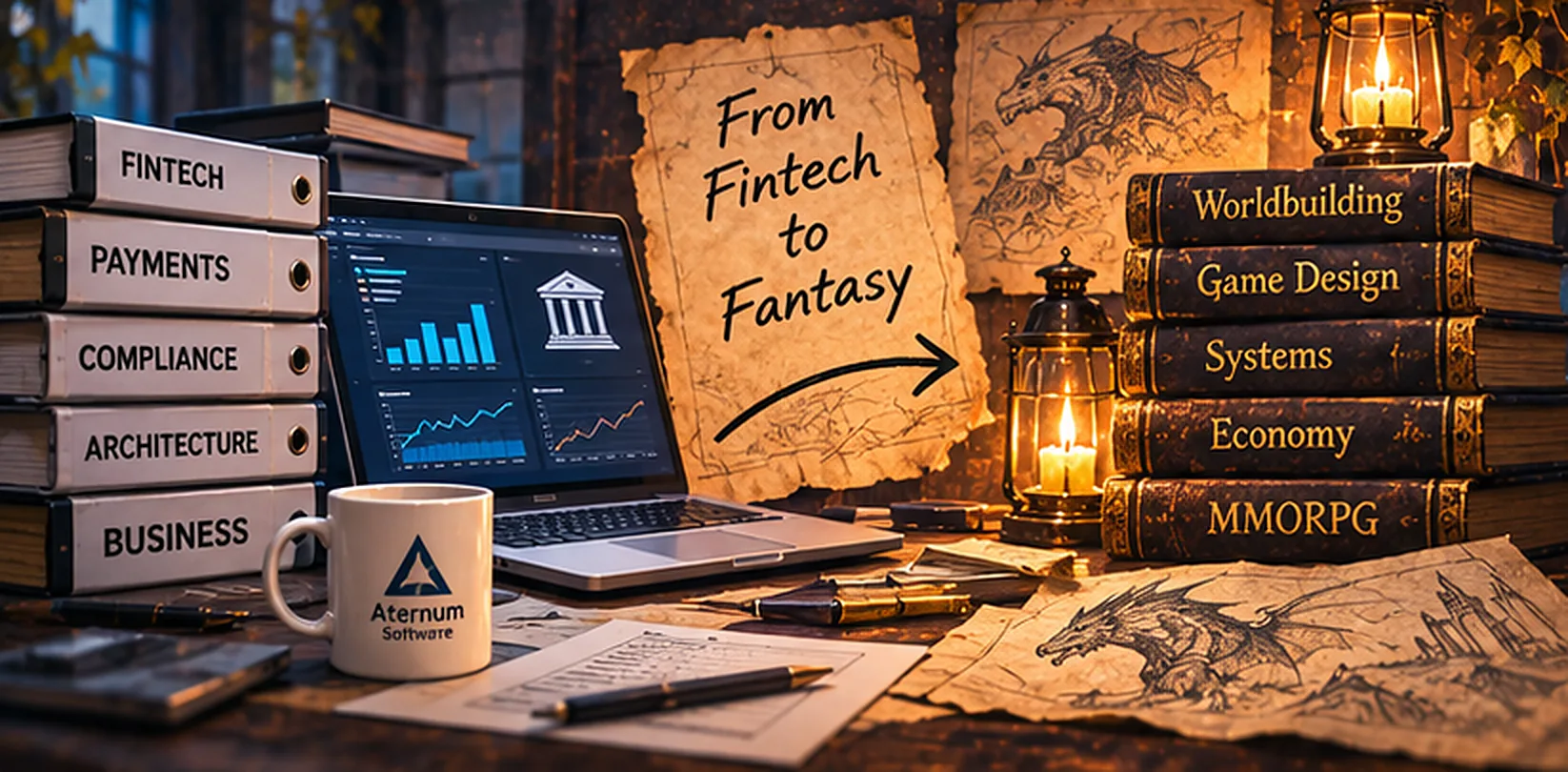
The transition might seem a little strange.
One day, you're working on financial systems, business logic, and application architecture.
The next, you're debating how the economy of a fantasy kingdom should function, what happens when a city gets conquered, and how long it should take a merchant to cross an entire continent.
Come to think of it, though, there are some similarities.
Both worlds require complex systems, consistent rules, resource management, and people making wildly unpredictable decisions.
With one small difference: in a fantasy world, when a business negotiation goes particularly badly, someone might pull out a sword.
Our professional experience doesn't automatically make us game development experts. Making video games involves artistic, technical, and creative challenges that are very different from building business software.
But it has taught us a few important things: how to design systems, tackle complex problems, recognize mistakes, and, most importantly, understand that having an interesting idea is not the same thing as having a working product.
We have a feeling that last lesson is going to come in particularly handy.
Our Vision: A Persistent, Player-Driven MMORPG
Project Chronicle was born from a question we keep coming back to:
What if an online fantasy world could actually remember what its inhabitants do?
We don't just want to build a world full of quests to complete, monsters to kill, and loot to collect.
We love those experiences, and we want them to play an important role.
But we're imagining something that goes further.
A fantasy survival sandbox MMORPG, where exploration, combat, character progression, and PvE content coexist with social, economic, and political systems influenced by the actions of players.
Imagine a region thriving because of its trade routes. A settlement growing from a tiny camp into a bustling town. A guild becoming powerful enough to change the balance of an entire territory.
Or a war disrupting a major trade route, forcing merchants and adventurers to seek new opportunities elsewhere.
Our ambition is to create a world where these stories don't all have to be written in advance by developers.
A world where players help write them.
And, most importantly, a world that continues to exist and evolve over time.
We're not envisioning periodic cycles where everything gets wiped clean so everyone can start over.
The direction we're exploring is a persistent universe, one capable of welcoming new generations of players without erasing the history created by those who came before them.
Of course, turning that vision into systems that are sustainable, fun, and balanced will be one of our biggest challenges.
But that's exactly the kind of challenge we want to take on.
A Survival Sandbox MMORPG That Respects Your Time
When people hear "survival sandbox MMORPG," it's easy to imagine a game that demands dozens of hours just to remain competitive.
We understand the appeal of complex games.
We also understand how frustrating they can become.
That's why we're thinking carefully about balance.
We want players who enjoy exploration, fighting monsters, tackling dungeons, and developing their characters to have a satisfying experience.
And we want players who prefer crafting, trading, settlement building, diplomacy, or politics to have meaningful ways to shape the world.
Not everyone needs to become a king, a general, or a merchant.
Some people might just want to explore a forest, clear a dungeon, and come home with better gear.
Preferably without having to file their character's annual tax return.
We've had quite enough of that in real life.
And What About Artificial Intelligence?
Yes, we're using it.
And no, we didn't just type "Make World of Warcraft, but bigger" into a prompt and wait for a video game to magically appear.
We're using AI tools to support research, design, development, and day-to-day production tasks.
Coming from the software industry, we're particularly interested in discovering how far these tools can help a small team go when tackling projects traditionally associated with much larger studios.
But AI is a tool.
It's not a replacement for vision, design decisions, or the skills required to make a good game.
And it certainly doesn't eliminate the need to test, fix, rebuild, and occasionally discover that an idea that sounded absolutely brilliant on paper is actually terrible when someone tries to play it.
We'll probably document those moments too.
There may be quite a few.
Building Project Chronicle in Public: Our MMORPG Devlog
This brings us to one of our most important decisions.
We want to develop Project Chronicle openly, involving the community from the very beginning.
We don't want to suddenly appear out of nowhere with a spectacular trailer and a collection of promises nobody can verify.
We want to share the journey.
The ideas, the decisions, the prototypes, the successful experiments, and the ones we'd probably rather nobody ever saw.
We'll share real development progress, the problems we encounter, and the reasoning behind many of our design choices.
We'll also do our best to clearly distinguish between what we envision for the future, what we've actually designed, and what's already working in the game.
Because having an ambitious vision is relatively easy.
Turning that vision into a genuinely good video game is an entirely different story.
And we want you to follow that story as it unfolds.
That doesn't mean every decision will be made through a community vote.
It means we'll listen to ideas, criticism, and suggestions, and we'll try to challenge our assumptions alongside people who share our passion for these kinds of games.
So, Are We Actually Going to Pull This Off?
Excellent question.
We have a vision, experience building software, a probably concerning amount of documentation, and the determination to tackle a complex project with a methodical approach.
But Project Chronicle is still at the very beginning of its journey.
We're not here to sell you certainties we can't honestly offer.
There are major technical, creative, and production challenges ahead.
Some ideas will change. Others will need to be scaled back. And we'll probably have to abandon a few along the way.
Our goal isn't to prove that a small team can magically build absolutely anything on its own.
It's to discover how far we can go by combining experience, modern tools, a disciplined approach, and a community involved from day one.
And maybe, one day, we'll log into Project Chronicle and find a world whose history has been written primarily by the people living in it.
This Is Just the Beginning.
We don't know how many times we'll have to rewrite a combat system.
We don't know how many seemingly brilliant ideas will survive their first playtest.
And we certainly don't know how often we'll find ourselves wondering why we didn't just start with a simple 2D platformer.
But we do know why we want to try.
We love virtual worlds where our actions matter. And we want to try building one.
If you love survival games, sandboxes, MMORPGs, and especially the idea of being part of a persistent world from its earliest days, we'd love to have you along for the ride.
Follow our development journey, tell us what you think, and don't be afraid to challenge our ideas.
In the meantime, we'd better get back to work.
We've got an entire world to build.
And apparently, we've decided to start with the foundations.
Welcome to Project Chronicle.
— Erwin & Federico, Aternum Games
Serious engineers. Questionable ambitions.